크리노이드
Crinoids are marine animals belonging to the phylum Echinodermata and the class Crinoidea. They are an ancient fossil group that first appeared in the seas of the mid Cambrian, about 300 million years before dinosaurs. They flourished in the Palaeozoic and Mesozoic eras and some survive to the present day.
바다나리는 극피동물문과 바다나리강에 속하는 해양 동물입니다. 그들은 공룡이 출현하기 약 3억년 전인 캄브리아기 중기 바다에서 처음 나타난 고대 화석군입니다. 그들은 고생대와 중생대에 번성했으며 일부는 현재까지 살아 남았습니다
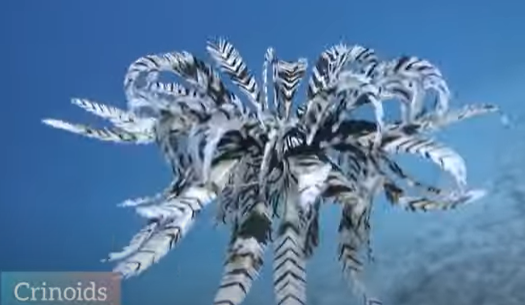
The term crinoid (CRY-noid) is derived from ancient Greek, krinon, meaning “lily,” because some crinoids resemble the flower.
Crinoids are commonly known as sea lilies due to their "flower-like" appearance , though they are animals, not plants.
Crinoids are echinoderms related to starfish, sea urchins, and brittle stars.
Today, more than 660 species of living crinoid have been identified, and more than 6,000 fossil species have been described, with the oldest dating to the Tremadocian Stage (485.4 – 477.7 million years ago) of Ordovician Period. In the sections that follow, we will explore the anatomy of crinoids before looking at their diversity and ecology from the Ordovician to the present.
크리노이드 (CRY-noid) 라는 용어는 일부 크리노이드가 꽃과 비슷하기 때문에 "백합"을 의미하는 고대 그리스어 krinon 에서 파생되었습니다.
크리노이드는 식물이 아니라 동물이지만 "꽃과 같은" 모양 때문에 일반적으로 바다 백합으로 알려져 있습니다.
크리노이드는 불가사리, 성게, brittle stars와 관련된 극피 동물입니다
오늘날 660종 이상의 살아있는 크리노이드가 확인되었고 6,000종 이상의 화석 종이 기술되었으며 가장 오래된 것은 오르도비스기의 트레마도키아기(4억 8,540만~4억 7,770만 년 전)까지 거슬러 올라갑니다.
Crinoids can very basically be described as upside-down starfish with a stems. The stem of a crinoid extends down from what would be the top of a starfish, leaving the mouth of the organism opening skyward, with the arms splayed out. However, crinoid arms look articulated and feathery. The stalk extends down from the aboral surface of the calyx. The stalk column has holdfasts which attach the animal to substrate.
Crinoids는 기본적으로 줄기가 있는 거꾸로 된 불가사리로 설명할 수 있습니다. crinoid의 줄기는 불가사리의 꼭대기에서 아래로 뻗어있어 입이 하늘을 향해 열리고 팔이 벌려집니다. 그러나 crinoid 팔은 관절이 있고 깃털처럼 보입니다. 줄기는 꽃받침의 aboral 표면에서 아래로 뻗어 있습니다. 줄기 기둥에는 동물을 기질에 부착시키는 고정 장치가 있습니다.
Most sea stars and sea urchins are mobile and actively search for food, but stalked crinoids attach to a firm object or the seafloor. They rely upon currents to bring small organic particles and plankton. Whereas seas stars have mouths on their undersides, crinoid mouths are directed upward. Feather-like arms contain “food” grooves lined with sticky tube feet. The tube feet catch organic particles suspended in the water and pass them along the grooves in the arms to the central mouth.
대부분의 불가사리와 성게는 움직이며 적극적으로 먹이를 찾지만, 줄기가 있는 크리노이드는 단단한 물체나 해저에 붙습니다. 그들은 작은 유기 입자와 플랑크톤을 가져오기 위해 해류에 의존합니다. 불가사리는 아랫면에 입이 있는 반면 크리노이드 입은 위쪽을 향합니다. 깃털 모양의 팔에는 끈끈한 관발이 늘어선 "음식" 홈이 있습니다. 튜브 발은 물에 부유하는 유기 입자를 잡아 팔의 홈을 따라 중앙 입으로 전달합니다.
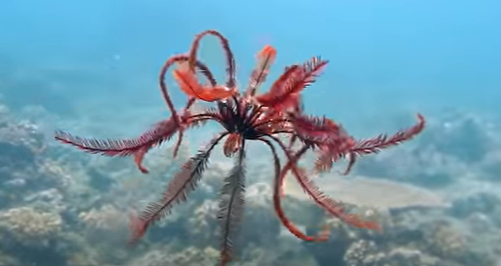
In today’s oceans, the majority of crinoids are capable of moving themselves. Some species of comatulids (i.e., feather stars) are even capable of swimming for short periods. Those that cannot swim, including some feather stars and the isocrinids, move instead by crawling along the seafloor. By being mobile, these crinoids can position themselves for more efficient filter feeding and, critically, mobility allows the crinoids to escape some of their predators, like sea urchins and fish.
오늘날 바다에서 대부분의 크리노이드는 스스로 움직일 수 있습니다. comatulids의 일부 종(즉, 페더 스타)은 짧은 시간 동안 수영할 수도 있습니다. 일부 페더 스타와 아이소크리니드를 포함하여 헤엄칠 수 없는 것들은 대신 해저를 따라 기어서 이동합니다. 이동함으로써 크리노이드는 보다 효율적인 필터 섭식을 위해 위치를 잡을 수 있으며, 결정적으로 이동성은 크리노이드가 성게와 물고기와 같은 일부 포식자로부터 벗어날 수 있게 합니다.
Well, kind of. A Crinoid’s feather-like arms are covered with a sticky mucus which traps food that happens to float past. Then, the tiny tube feet that cover the arms, pass the food particles to the centre of the arm where it is transported to their mouth.
Crinoids are commonly found in water deeper than 200 metres, but sometimes the variety without stalks will be seen in much shallower water.
Crinoid의 깃털 같은 팔은 우연히 떠다니는 음식을 가두는 끈적한 점액으로 덮여 있습니다. 그런 다음 팔을 덮고 있는 작은 관족이 음식물 입자를 팔 중앙으로 전달하여 입으로 운반합니다.
크리노이드는 일반적으로 200m보다 깊은 수심에서 발견되지만 때로는 훨씬 더 얕은 물에서 줄기가 없는 종류를 볼 수 있습니다.
 홈 > 영어컨텐츠 > Today's Issue